Showing posts with label women. Show all posts

Tuesday, November 1, 2016

What RDs Do: Ellen Albertson, PhD, RDN, CD

DR. ELLEN ALBERTSON
PSYCHOLOGIST, NUTRITIONIST, WELLCOACH &
MINDFUL SELF-COMPASSION TEACHER
for something nutrishus


I reached out to Ellen on the advice of interviewee Jean Caton as she had recently featured her on her podcast. It was so great to hear about a dietitian/psychologist and learn all the amazing things she's done on the path to her current career. She has a unique niche looking at women's wellness and how we treat ourselves, not just the food we eat.

Why did you become a RD?

I was looking for a change in career direction and had always been interested in nutrition and love working with people to help them live healthier lives.

What area of dietetics do you work in?

Coaching/counseling, speaking and writing in a variety of areas including: weight management, diabetes and women’s health. I also specialize in helping women make peace with their bodies and food.

How would you explain what you do?

I take a holistic—body, mind, heart & spirit—approach to empower people to optimize their health & wellbeing. I help women achieve health, happiness and balance so they can reach their full potential quickly & effectively without stress.

What are your ‘typical’ daily/weekly tasks? 

Social media (writing and posting), public speaking, counseling/coaching, networking and podcasting.

What has been your career path?

• Clinical dietitian (inpatient and outpatient)

• Nutrition/health journalist (I’ve writen for numerous publications including Self, Good Housekeeping & Better Homes & Gardens)

• Celebrity Chef - I was half of The Cooking Couple™ with my husband. We had a nationally syndicated radio show, wrote books and did product endorsements.

• Master Personal Fitness Trainer

• Online nutrition expert for Rodale (Men’s Health, Women’s Health & the Abs Diet)

• Wellness Coach (current)

• Writer/Podcaster (current) -just released my 4th book (The Diabetic & The Dietitian) and starting a podcast called, Wellcouples.

What advanced education or special training do you have? 

I have a PhD in psychology, Certified Wellcoach®, Reiki Master, Mindful Self-compassion Teacher, Training in Intuitive and mindful eating and diabetes management, Certification in Adult Weight Loss Management, previous certs as personal fitness trainer.

In an ideal world, what does the industry look like 5 years from now?


Focusing on making healthy eating fun, easy, accessible & affordable. Improving the food supply. NO more dieting instead using mindful or intuitive eating. Acceptance of a variety of healthy body sizes especially for women.

What misinformation about RDs would you like to clear up?


We’re not the food police. We can be flexible and work with you to create a healthier lifestyle

What would you like people to know about RDs?


Many of us are foodies and love eating.

What are challenges you encounter as a RD?

Respect from doctors. Moving clients who are stuck into action.

What do people think that you do for a living?

Help people lose weight.

What are you passionate about in dietetics?

Helping women heal their issues around negative body image and dysfunctional eating. Ending dieting. Introducing RDs and other health practitioners to self-compassion as a motivational tool.

What makes RDs unique/different from other nutrition/wellness professionals?

Solid, evidence based education. Our diversity. We do so many different things.

What is your favourite meal?

My husband’s barbecue!

What tip(s) would you give to our readers?

Stop beating your body up because it’s not “perfect.” Replace the self-loathing with self-love/self-compassion. It’s much more effective. There are a wide variety of ways to live and eat to be healthy!

Anything else you’d like to add that you feel would be valuable:

I’ve been an RD for 23 years and love it as a career. I continue to evolve and grow in terms of how I help people.

More about Ellen:

Twitter: @eralbertson
Facebook: Dr Ellen Albertson
LinkedIn: Ellen Albertson, PhD, RD, CD
Website: Dr Ellen - Empowering Women at Midlife
Website: SmashYourScale.com


Thanks Ellen! Find out more about What RDsDo.

If you're a dietitian that would like to be featured, email me for the details!

Monday, March 10, 2014

Courage & Change - A Reflection

Last week I attended a local screening of LUNAFest - short films by, for, about Women.  Our local theatre was full of women of all shapes, sizes, and ages - it was so great to see! Since Saturday was international women's day, it was fabulous to be in a room full of women celebrating women. 

The event consisted of 9 short films, all of which had great messaging and emotion coming through. A few of them stood out a bit more or spoke to me on a deeper level.

Granny's Got Game - having been an athlete most of my life and knowing senior/master level athletes, this one hit home because I loved seeing how competitive these women still were in their 70's and the camaraderie that they enjoyed with their teammates. It was also great to see that they were still quite active and loving the game; the all had their own challenges, but spoke of the time together as some of the best in their life.    

Flying Anne - a young girl with Tourette's syndrome and her struggle to manage tics, fit in, and explain herself to her classmates. It was quite touching when she said she wouldn't give up her Tourette's if she could, because it's part of who she is - to be so young and so courageous is amazing to me.

First Match - another sport filmed, but this time focused on a female wrestler in her first co-ed match. She was a great athlete and had to deal with her peers and her father's opinion about wrestling with the boys; that definitely took a lot of courage, but she stayed true to who she was.

I enjoyed all of the films, and the writers/directors each had a very unique approach to share their message. I just kept thinking of how women worry so much about what other's think, spend many hours (and their money) caring for other people (even strangers), and how we all have our own struggle, but it's only a struggle if we see it that way.

This year the theme for international women's day also fits with my interests: Inspiring Change.  The focus was on advancement of women, equality, and challenging the status quo. I work with clients on small changes they can make for their health and wellness, but on a large scale there is still so much to do around the globe to ensure that women get the opportunities they deserve. A change I would like to see is a change in how women view themselves - whether it be their skills, their looks, or their self-worth. I see so many women that are hard on themselves or trying to live up to someone else's ideals.

I continue to work at not comparing myself to others (that athlete competitiveness is always there!), and work daily to be the best me that I can be. I hope you can find inspiration to be courageous, be authentic, and be the best you!

Celebrate the women in your life everyday!
See quotes that inspire me on my Pinterest page.

Steph Langdon, RD
something nutrishus counselling & coaching
www.nutrishus.com

Thursday, March 8, 2012

International Women's Day 2012

The theme for International Women's Day this year is: Empower Rural Women - End Hunger and Poverty.  Below I have included Goal 1 from the United Nations Millennium Development Goals.  

"In many countries women supply most of the labour needed to produce food crops and often control the use and sale of food produce grown on plots they manage. However, the gender disparities in ownership of, access to, and control of livelihood assets (such as land, water, energy, credit, knowledge, and labour) negatively affect women's food production." 

 Goal 1: Eradicate Extreme Poverty and Hunger

Rural Women's Poor Access to Infrastructure in Rural Areas Limits their Opportunities to Reduce Poverty and Hunger
Figure 1
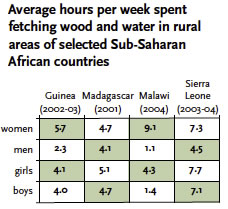
Figure 1: Average hours per week spent fetching wood and water in rural areas of selected Sub-Saharan
African countries
Source: UNDP 2011
Rural women spend more time than urban women and men in reproductive and household work, including time spent obtaining water and fuel, caring for children and the sick, and processing food. This is because of poor rural infrastructure and services as well as culturally assigned roles that severely limit women's participation in employment opportunities (see also Goals 3 and 7).
Faced with a lack of services and infrastructure, rural women carry a great part of the burden of providing water and fuel for their households. In rural areas of Guinea, for example, women spend more than twice as much time fetching wood and water per week than men, while in Malawi they spend over eight times more than men on the same tasks. Girls in rural Malawi also spend over three times more time than boys fetching wood and water (Figure 1). Collectively, women from Sub-Saharan Africa spend about 40 billion hours a year collecting water [2].
Figure 2
Figure 2
Source: FAO 2011
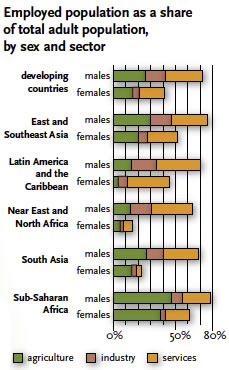
For these reasons and because rural women tend to underreport their employment as contributing family members, according to available data female employment in agriculture is consistently lower than it is for men across the total adult population in developing countries, although it varies greatly by region (Figure 2). The jobs of rural women who are employed tend to be shorter term, more precarious and less protected than those of rural men and urban people. The lack of flexible hours to accommodate family work combined with wage and job discrimination and limited representation of women in workers' organizations are partly responsible for this.
As an Important Source of Livelihoods for the Poorest, Agriculture is a Means to Eradicate Extreme Poverty, Especially for Rural Women
Despite women's lower overall employment rates, among employed women the proportion working in agriculture as opposed to other sectors is usually equal to or higher than the male equivalent. Almost 70 percent of employed women in South Asia and more than 60 percent of employed women in Sub-Saharan Africa work in agriculture [3]. The substantial involvement of rural women in agriculture, primarily as unpaid or contributing family workers, highlights the importance of developing policies and programmes that address the needs, interests and constraints of women as well as men in the agriculture sector. This includes revamping and strengthening extension systems to be more responsive to and inclusive of women, addressing structural barriers to women's access to productive resources, and improving financial systems to respond to the needs of rural women producers and entrepreneurs, including to move out of the less productive segments of the rural economy [4].
Improving Rural Women's Access to Productive Resources is Central to Addressing Hunger
On average, women make up about 43 percent of the agricultural labour force in developing countries. Evidence indicates that if these women had the same access to productive resources as men, they could increase yields on their farms by 20 to 30 percent, raising total agricultural output in developing countries by 2.5 to 4 percent, in turn reducing the number of hungry people in the world by 12 to 17 percent [5]. For rural women and men, land is perhaps the most important household asset to support production and provide for food, nutrition and income security. Yet an international comparison of agricultural census data shows that due to a range of legal and cultural constraints in land inheritance, ownership and use, less than 20 percent of landholders are women [6]. Women represent fewer than 5 percent of all agricultural land holders in North Africa and West Asia, while across Sub-Saharan Africa, women average 15 percent of agricultural land holders [7].
Extensive evidence shows that rural female-headed households also have more limited access than male-headed households to a whole range of critical productive assets and services required for rural livelihoods, including fertilizer, livestock, mechanical equipment, improved seed varieties, extension services and agricultural education [8]. Similarly, in seven out of nine countries across Africa, Asia and Latin America, female-headed households were less likely to use credit than male-headed households [9].
Figure 3
Figure 3
Source: FAO, 2011. FAO elaboration.
Rural Women's Economic Empowerment Can Help Reduce the Number of Underweight Children
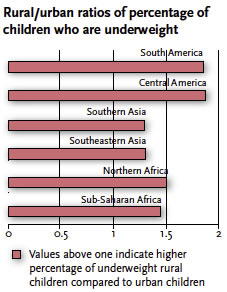
A large body of research indicates that putting more income in the hands of women translates into improved child nutrition, health and education [10], yet data on child nutrition disaggregated by both rural/urban location and sex are sparse. In all developing regions [11] of the world, rural children are more likely to be underweight than their urban counterparts. From 1990 to 2008, the proportion of children under five in developing regions who were underweight declined from 31 per cent to 26 per cent, yet in parts of Latin America and the Caribbean, and Asia, the disparity between rural and urban children increased [12]. Figure 3 indicates that in South and Central America, rural children are about 1.8 times more likely to be underweight than their urban counterparts; other regions do not fare much better. Improvements in maternal nutrition, access to water and sanitation and health services, all of which are lacking in many rural areas in least developed countries (LDCs), would also contribute greatly to addressing this situation.


Steph (Wheler) Langdon, RD

something nutrishus counselling & coaching

www.nutrishus.com

Tuesday, March 8, 2011

International Women's Day 2011


As a woman and a business owner, I am especially happy to celebrate International Women's Day (IWD). You can find out more (events happening around the world, what people are saying, what IWD is...) on the IWD website.

This year is the 100th anniversary of IWD and the United Nations theme is: Equal access to education, training and science and technology: Pathway to decent work for women.
As a sole proprietor in a science based industry I really feel that this is an important issue. We may not see it as clearly in our great country, Canada, but it is true that women still fight for equality. Through my memberships in the Saskatoon Women's Network and Women Entrepreneurs of Saskatchewan I have had the opportunity to meet many successful women in my own city and province. It is very encouraging to someone like me who is still new to the business world.

Steph Wheler
www.nutrishus.com