Showing posts with label variety. Show all posts

Thursday, October 29, 2015

Day 29: Variety is the Spice of Life

I enjoy food (as most dietitians do) and I enjoy cooking. This means we're often trying new ideas, tools/methods, ingredients or recipes in our kitchen. We've also been introducing food to our daughter over the past 5 months, so that has kept us thinking about different things to have her try. We do also enjoy eating out and trying different restaurants. If we go out (which is less these days, now that we're parents), it would be for food that we don't make or don't make often, thus it's often ethnic cuisine.

I don't love every food, my husband has a few that he enjoys that I'm not as fond of (oysters, blue cheese, olives). I also don't always make great things in the kitchen, sometimes new ideas flop. We try to find recipes with comments and suggestions so that we can learn from others, but we don't all like the same things either.

I think it's great to have access to many foods. There are varieties in Saskatoon that I don't remember seeing as a child and some foods are now available all year round. We're able to buy fresh, frozen, or canned items and often the store has what we're looking for. I know not everyone has that luxury. I travel to some small communities with my work and see the lack of choices, or even the lack of a store, or high prices that can be limiting.


I am walking distance from groceries, which I love. I can go for a walk to grab a few items I need. I also don't have to eat the same things as my husband or daughter, if I don't want to. We don't have allergies or other dietary restrictions, so for us it's just a matter of preference. As she gets older and starts talking, our daughter may let us know more about her likes and dislikes, but so far we're pretty lucky, like us, she likes food and hasn't had a bad reaction to any of it.


I am grateful for: access to a wide variety of foods

As a Canadian I enjoy being able to eat Italian, Mexican, Thai, Vietnamese, Chinese, East Indian, and locally sourced foods. I love to travel and part of that is definitely to try other/new foods.

Try something new or pull out an old favourite that you've forgotten about, explore the world of flavours available to you!
Steph Langdon, RD
www.nutrishus.com

Wednesday, September 3, 2014

Using Your Garden Goods

I enjoy situations that cause me to be creative and find new ways to use ingredients. This year that inspiration has come from our CSA PayDirt farms. We have received 4 deliveries of locally grown, organic produce so far this year and I have whipped up a variety of new dishes in the kitchen to enjoy the fresh ingredients. We split a share with my brother-in-law and his fiance since we both only have 2 mouths to feed and want to make sure we're able to use everything up. These situations challenge me, because like most people I have my go to items from the grocery store. I do try to combine them in different ways, but this year I've had more chard and mustard greens than I knew what to do with!

As summer sadly comes to an end and gardens are emptied I also like to enjoy the flavours of the changing seasons. Seeing different items at the market or store can also serve as an inspiration; I know I've been enjoying as many peaches and nectarines as I can before they're gone. Earlier this summer that also included cherries and berries, and now corn on the cob is out in abundance.

I also use social settings to test out new recipes and will cook in big batches to get us through a busy work week. Needless to say, there are lots of outside influences when it comes to what is created in my kitchen. We do have our standard favourites, but I like to think that we get a good amount of variety as well.

A few recipes that I've used lately and wanted to share include breaded green beans and a new take on potato salad.

The green beans were adapted from for the love of cooking as they were baked and most recipes involved frying.  I brought them to a potluck and they disappeared; I will definitely make them again. I posted the picture below on my instagram feed and someone asked for the recipe, so here it is...

Baked Breaded Green Beans
Ingredients
1-2 lbs of green beans, washed and ends trimmed
1 egg
2 Tbsp milk
1 cup bread crumbs
spices (I used a smoked paprika, garlic, chili, and chives blend that I had)
2-3 Tbsp vegetable oil
salt and pepper
4 Tbsp mayo
2 tsp soya sauce
1 clove garlic, minced
1-2 Tbsp sriracha sauce

Directions
1. Combine  2 Tbsp mayo with soya sauce and garlic - set aside. Combine remaining 2 Tbsp mayo with sriracha - set aside.
2. Line a baking sheet with aluminum foil and brush with 1 Tbsp of vegetable oil. Preheat oven to 425F.
3. In a small bowl make a milk bath with your egg and milk. In a separate bowl combine bread crumbs, spices, and salt and pepper.
4. Dip beans in egg bath and crumb mixture; place in a single layer on baking sheet.
5. Drizzle remaining oil over beans and bake for 13-15 minutes.
6. Serve immediately with dipping sauces.

-----

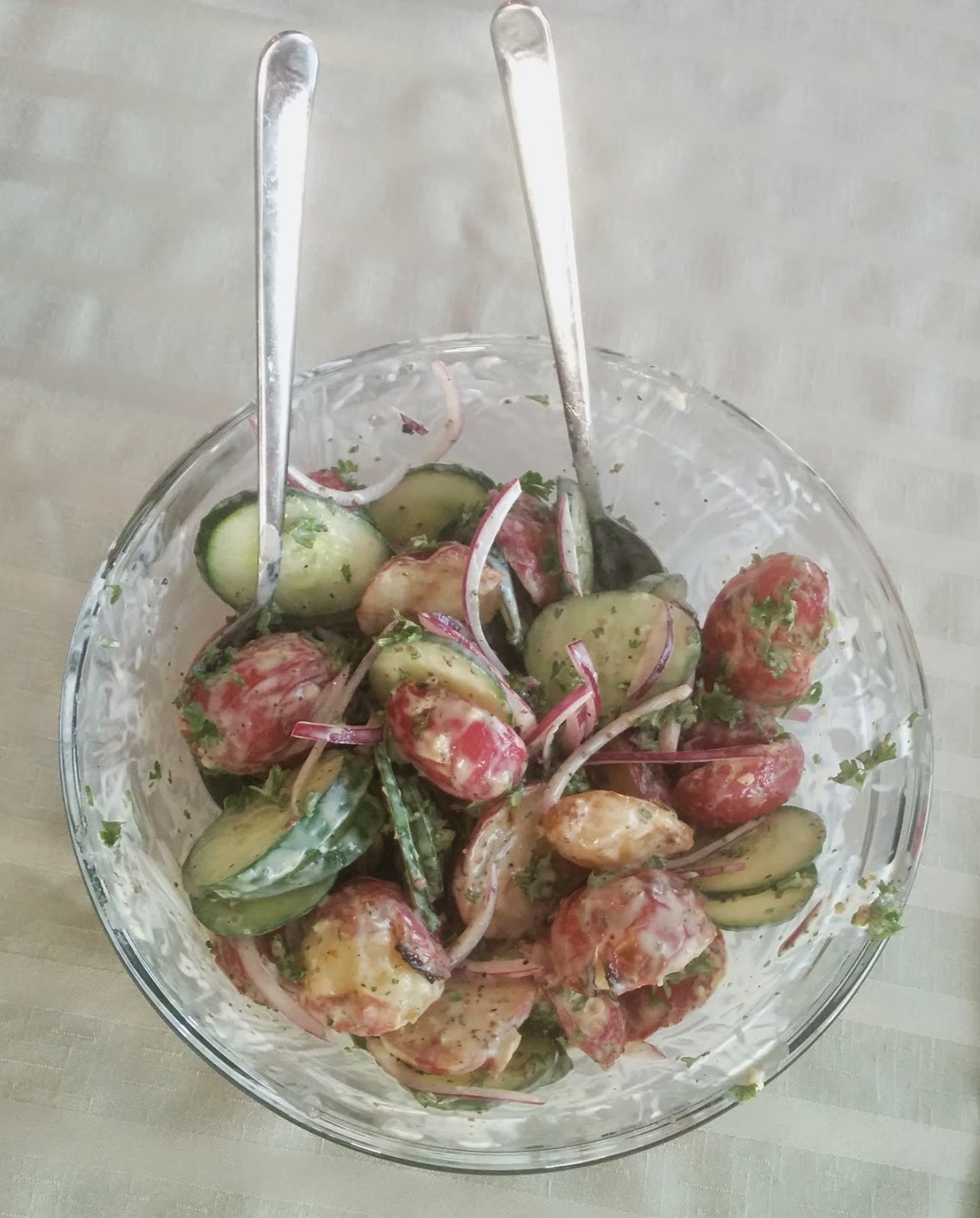
The Creamy Cucumber and Grilled Potato Salad recipe comes from Food & Wine and was the dish I took to my August foodie group evening. Our theme was grilled food and I picked up my ingredients from our local farmer's market. It was a hit and is also a recipe I will make again.

What have you been inspired to try or create this summer?

Enjoy your garden goods while they last!
Steph Langdon, RD
something nutrishus counselling & coaching
www.nutrishus.com


Tuesday, June 3, 2014

Happy Hours

I apologize for my recent absence from the blog - I have still managed to do the monthly ReDux challenges, but I haven't been posting as often as I'd like. In the meantime, I hope you've been visiting the Nutrishus facebook page and my instagram account to see what I've been up to, what's happening in the world of nutrition, and what I'm making in my kitchen.

I've been taking part in #100happydays since April 28, and have been sharing that on instagram as well. It relates well to my former posts about mindfulness, gratitude, and being in the moment. No matter what the day is like, I look for at least one source of happiness to focus and reflect on - I personally think it's a great exercise (however you choose to find your happiness).

Part of my absence has been a reflection on my life as an entrepreneur. I get so many ideas, and often need time to sort through them in order to decide where to spend my time and energy. I'm hoping to get more clarity around that this summer and set some goals to keep me focused. As you know, goals are very important, they involve action, and help use accomplish things and change habits.

I had a client recently state "I don't know where to start". Taking on our health can seem overwhelming, but I am still a strong believer in variety, moderation, and balance (although you need to consider how you define each term) as well as making small changes now for lifelong results.

Perhaps that means spending 10 minutes tonight washing and chopping vegetables while your supper is cooking. Those veggies can then be eaten the rest of the week raw as a snack, used in salads/stirfries/omelets, or thrown on the grill if you're cooking more outside these days. For many people, healthy eating goals need to focus on increasing vegetables (and fruit); so be brave and purchase a new variety the next time you're grocery shopping or hit up the local farmer's market. If you don't know what to do with the new ingredient, you can often find recipes in stores, talk to a friend or co-worker, or use google or pinterest for inspiration. Don't feel like you have to eat 3 new meals for the next 7 days, just focus on one meal this week, or cook in big batches so that you have leftovers and one less meal to plan during your busy week. I know I like leftovers this time of year because it means I'm using the stove less and keeping my home cool.

In case you're looking for happiness in a song or need something to listen to while you're cooking tonight, here is Pharrell Williams's 24 hour music video - Happy:


Here's to many happy hours in your kitchen and in your healthy future!
Steph Langdon, RD
something nutrishus counselling & coaching
www.nutrishus.com

Monday, January 20, 2014

Personalized Pizza {Recipe ReDux}

We don't make or order pizza often at our house, but I know it's something that my husband and I agree on - we both love thin crust pies that remind us of our time in Rome (simple, flavourful ingredients).  We've successfully made our own with caputo 00 flour and san marzano tomatoes, but when I have a crowd to feed or need to make a meal in a hurry, I turn to pita pizzas.  I have yet to try using eggplant or pureed cauliflower as a crust, but I've pinned them to try in the future.

Pita pizzas are a great way to use up leftover vegetables, protein, and cheese, or to make extra veggies to be used later in the week with eggs, salads, etc.  Knowing that many of my clients prep food on the weekend, it's always great to think about planned extras and take advantage of the time you have, since we know there will be evenings when you need to get something on the table fast!
This month's Recipe ReDux challenge is Pizza Party! Give the delivery guy a day off; whether it is for Friday Fun Night with the kids, a pizza chef competition among friends, or for Super Bowl Sunday (February 2). Share your healthy pizza recipe that we can all look forward to after a long week…or a long day.


Pizzas are great since everyone can choose their own toppings.  You basically need the pitas, a sauce, lots of vegetables, and protein (cheese, chicken, sausage, my husband has even tried oysters).  You can be creative and use up what you have while creating a new favourite flavour combination.  Lately I’ve been loving roasted vegetables and Mediterranean flavours, which is what inspired me for this month’s challenge.

Personalized Pita Pizzas
Makes 4 pitas

Ingredients:
Olive oil
1 pint (~40) cherry tomatoes, halved
4 cloves of garlic, minced
1 artichoke, rinsed
1 1/2 – 2 cups of white mushrooms, sliced
1/4 – 1/3 red onion, thinly sliced
1 handful spinach
1/3 cup feta, crumbled
2 Tbsp cream cheese (optional, flavoured)
1 Tbsp milk
4 whole wheat pitas
Salt and pepper

Directions:
  1. Roast tomatoes: preheat oven to 250F. Place parchment paper on a baking sheet and top with tomatoes, garlic, and 1 Tbsp olive oil.  Place on centre rack and roast for 1 1/2 – 2 hours, stirring/turning once and removing once aromatic and shrivelled to your heart’s content.  This can be done ahead of time and refrigerated for when you want to quickly make pizza.
  2. Cooking the artichoke: I chose to do this as a challenge to myself since I’ve only used the hearts in the past.  There are many videos on youtube if you’re also new to purchasing and cooking with artichoke. Start by removing the coarse leaves close to the stem, trimming the tiny thorns from the outer leaves with kitchen shears, trimming 1/8” off the stem, and using a sharp knife to trim about 1/2” off the top. Bring a pot of water (with a dash of salt) to a boil and add your artichoke; cook for 35-40 minutes (it’s done when an inner leaf comes off easily).  This can also be done ahead of time, and then you can also enjoy eating from the leaves.  Once you get to the heart, chop it and set aside.
  3. Heat 1 Tbsp of olive oil in a sauce pan over medium heat and add mushrooms.  Sauté 3-5 minutes to desired level of doneness (option to add a dash of salt). Remove from heat and set aside. 
  4. Using the same saucepan, sauté red onion until lightly browned. Remove from heat and set aside. 
  5. Use that saucepan one more time and heat up 2 Tbsp of cream cheese (we used herb and garlic) and 1 Tbsp of milk to make a white sauce.
  6. Preheat oven to 425F and start prepping your pizzas.  Lightly spread white sauce on four pitas and top with desired ingredients (tomatoes, onion, artichoke, mushrooms, spinach, and feta). Season with black pepper and place in heated oven for 8-10 minutes until cheese is melted and edge is golden brown.  Let cool 1-2 minutes, slice and enjoy!
How do you enjoy "pizza" and what are your favourite toppings?

Steph Langdon, RD
something nutrishus counselling & coaching
www.nutrishus.com


Monday, August 19, 2013

A World of Flavours

One reason I love traveling is because you get to experience different cultures and their foods.  There may be similar ingredients, but perhaps they are used in different ways.  When I talk about mindful eating, that involves enjoying the many flavours of your food.  Whether you're cooking the food yourself or lucky enough to just get to eat it (I love cooking, don't get me wrong!), it's important to stop and savour the tastes - the sweetness of cinnamon, the 'meatiness' of cumin, the memories I have that I associate with mint.  We will all have preferences and familiar flavours, but I do enjoy cooking with different ingredients and spices and seeing/experiencing how other people flavour their food.

The smells are also very important when we think of taste and flavour.  My mom used to say to start sauteing onions and garlic to at least give the impression that the meal is on the way (even if you still have lots of prepping, you'll also have drooling guests).  I think I still need to work on my detection of different spices, but that just means I can continue to slow down and discuss my food with others and pick out the different flavours.  At my wedding shower, we played a 'guess the spice' game, which was a perfect game for a foodie bride, but the blends got me and I definitely wasn't the winner!

Many cities celebrate culture with a type of folk festival.  We just had ours in Saskatoon and I sampled great food and spent time with family and friends.  As we were leaving, my husband and I noticed some informational signs in the Caribbean pavilion, so I made sure to capture them to share with you.


They give some background on flavours used in Caribbean food and connections to Indian food (curry).  This reminded me of our cooking class in Thailand and how we noticed just a slight change in the ingredients meant a huge difference in the curry paste.

If you're like many people, you might have a cupboard full of spices, but you have your favourites (or the ones that you're comfortable using) and then you have ones that were in a rare recipe or that you don't know what to do with.  Spices can be a great ingredient to share with others since they may come in much larger portions than you need.  You can also start looking for new ways to spice up or flavour your meals.  Herbs and spices can be a great way to reduce salt, fat, and sugar in our diets, but still leave us feeling satisfied.

Dietitians of Canada has created a chart with suggested flavour enhancers to inspire your cooking efforts.  And if you're not sure what to do with that marjoram or cardamom, EatRight Ontario has brief descriptions and recipes for a variety of herbs and spices.  This may give you ideas for fresh herbs from your garden or local farmer's market as well.  There are also lots of infographics out there to help you create spice blends or determine which spices go best with which ingredients.

Here's to delicious food!
Steph Langdon, RD
something nutrishus counselling & coaching
www.nutrishus.com

Wednesday, August 7, 2013

That's a Wrap

I often ask about barriers to healthy eating and hear about a lack of time, being unsure of what to make, picky family members, etc.   Wraps can be a great way to get a quick and balanced meal (depending on the ingredients your choose).  Adding a glass of milk and/or piece of fruit for dessert can complete the meal as well. 

They also work as a meal on the go and when you set out ingredients, everyone can take part in the prep.  Coincidentally, for our theme this month, my foodie group is doing 'all things rolled'.  Wraps can help you use up random ingredients and encourage your to make more (protein, grain, veggies) at one meal and enjoy them in a different form (wrapped) at another meal so that you don't feel like you're always eating the same foods or the same leftovers.


I have previously posted a few wrapped meals that include Taco Salad Wrap (which I make often and have made in cooking demos) and Enchilladas (which I've only made once so far) - these were both bean based, but you can of course create your own variety (that's the joy of wraps).

Get creative with your ingredients (and seasonings)

Grain:
  • rice paper
  • tortillas
  • pitas
  • rice, quinoa, etc. (a great way to use leftovers and/or make planned extras)
Protein:
  • egg(s)
  • tuna, salmon, other leftover fish
  • chicken, steak, etc. (can be leftovers)
  • black beans, chickpeas, etc.
  • hummus
  • shredded low fat cheese
Vegetable/Fruit:
  • tomato
  • avocado
  • onion, red onion, green onion
  • grapes
  • celery
  • shredded carrots
  • leafy greens (spinach, romaine, arugula...) - can be the 'wrap' too
  • shredded cabbage 
  • apple
  • corn
  • cucumber
  • bell peppers
  • leftover grilled or roasted vegetables
My husband enjoys bringing ingredients to the lake for a quick lettuce wrap (great on hot summer days when you don't feel like cooking), so don't feel you always have to wrap with a grain.  I have athletes that like to grab a quick peanut butter and banana tortilla for an on the go meal/snack.  My go to would likely be a quick egg wrap (with spinach, vegetables that are available, a little cheese, and salsa) or we do Mexican themed wraps often as well.

If you're tired of salads, not sure what to do with your leftovers, or wanting to add some variety, why not try a wrap this week and see what you can create.

What do you wrap and roll?

Steph Langdon, RD
something nutrishus counselling & coaching
www.nutrishus.com

Tuesday, July 23, 2013

Incredible Edible

wedge salad
It's hot and humid and you don't feel like turning the stove on.  You want to enjoy the sunny evening and not be a slave to your kitchen.  Based on past experience, the idea of a salad may not excite you anymore.  However, with a few new combinations or ingredients, you can create a very tasty dish. 

Take advantage of local leafy greens and herbs and have fun adding different toppings for different flavours and textures (crunchy, soft, etc.).  Whether you're making a side salad or an entree, challenge yourself to pick and mix a new recipe.  As Jamie Oliver says "There are no rules, just start picking and mixing. Even using just 3 or 4 ingredients will give you a salad that rocks."

In Jamie's Food Revolution cookbook he provides a chart to guide you to pick a soft and a crunchy lettuce, herbs, veggies, cheese, and toppings such as seeds and nuts. You can see a visual of the chart on Jamie's Home Cooking Skills. 

Ingredients

  • a soft ingredient
  • a crunchy ingredient
  • a herby ingredient
  • a veg
  • a cheese
  • a topping
  • your favourite dressing
  • sea salt and black pepper

To make your pick-and-mix salad

1. Choose an ingredient from each
2. Wash and spin dry the soft and crunchy leaves
3. Pick the herby leaves off their stalks, discarding the stalks
4. Finely slice or peel the veg and shave, tear or crumble up the cheese
5. Toss everything together in a large bowl
6. Dress simply with your favourite salad dressing and season with a good pinch of sea salt and freshly ground black pepper, if needed 
7. Divide the salad between your serving bowls and sprinkle over your chosen topping

salad wrap
I also really like Jamie's 'chopped salads' and will throw together a variety of veggies and chop away.  We often dress our salads with some variation of olive oil, vinegar, spices, and pepper.  Recently at a friend's house for supper we had two beautiful salads (one from the host and one that we brought).  They were very different and equally delicious.  Think outside the salad bowl and try a lettuce wrap or a wedge salad.
Perhaps you even have a garden outside that can be your inspiration tonight or have a few fresh herbs left to experiment with.  As you know I think it's great to include children (and teens or partners) in meal planning or preparation - so ask them to choose a cheese, vegetable, and/or topping and see what you can create!

Happy eating!
Steph Langdon, RD
something nutrishus counselling & coaching
www.nutrishus.com

Monday, November 19, 2012

Pulses, Plants, and Prostates

Perhaps you or the men in your life are sporting a 'stache for Movember.  It's great to see people supporting men's health issues such as prostate cancer and bringing these issues to the forefront so that people feel comfortable talking about them.

As a dietitian, my first instinct is to look for ways to reduce the risk of prostate cancer and other chronic conditions with food.  It is often impossible to pinpoint one particular cause and as new research comes out, we may find new strategies.  However, often times the recommendations for one disease state are applicable to others, so we can all start eating to prevent disease and/or reduce our risk.   

To make the most of your food choices:
  • increase your intake of fruits and vegetables (include a variety of colours)
  • reduce your fat intake (this is also beneficial for heart health and weight management)
  • increase your intake of plant foods (vegetables, fruit, whole grains, nuts, seeds, beans, chickpeas, lentils...) and reduce your intake of animal foods (dairy, meat...); it's still important to get adequate calcium and vitamin D, just don't overdo it
  • include fish to make sure you're getting omega-3 fatty acids
  • if consuming alcohol, do so in moderation
  • increase your intake of isoflavones (soybeans, tofu, kidney beans, chickpeas, lentils, peanuts)
  • maintain a healthy diet
  • include regular activity/exercise
Certain foods may offer extra protection against prostate cancer including lycopene (found in tomatoes, tomato sauces, watermelon, grapefruit...), selenium (Brazil nuts, fish, poultry, sunflower seeds...), and vitamin E (vegetable oils, nuts, seeds, green leafy vegetables...).  As always, include a variety of different foods as no one food can give us everything we need.

Only a few more weeks until the razors come out!

Steph Langdon, RD
something nutrishus counselling & coaching
www.nutrishus.com

Friday, October 26, 2012

So Many Reasons...

I wanted to share a recent news release from Dietitians of Canada regarding the OMA's call to action for food taxes, different labelling, etc.  Remember, as a parent you are a role model and there is not just one factor causing today's obesity issues, there are so many reasons....

Dietitians agree that action is needed now to support more children to have a healthy weight


Toronto, ON – October 24, 2012.  Dietitians of Canada, the professional association representing dietitians from coast to coast calls for policies and programs that make healthy foods more accessible to children where they live, learn and play. “We all need to eat healthy food to achieve and maintain good health, including a healthy body weight,” says Janice Macdonald, Director of Communications. “We want children to enjoy healthy food most of the time,” she adds. The Association is responding to the recent call for action by the Ontario Medical Association, for aggressive new measures, including taxes on junk food, restricting marketing of fatty and sugary foods to children and policies that would dictate changes in food labelling.

There is no one way to make healthy eating the norm. School nutrition policies make a difference by limiting the availability of low nutrient foods and those high in fat, sugar and salt while kids are at school. Expanding nutrition policies to include recreation centres and children’s sports events furthers the impact. Dietitians have called for stricter controls on the advertising of unhealthy foods and beverages to children. The current system of self-regulation, although a step in the right direction, does not go far enough. This system needs to apply consistent, science-based standards to determine what and how food and beverages are advertised. The Dietitians of Canada position on advertising of food to children and its views on other food and nutrition issues, are available at www.dietitians.ca under ‘Dietitians Views’.

Parents are powerful role models and dietitians encourage parents and caregivers to get the whole family involved in meal planning, shopping and cooking. Eating together as a family as often as possible can result in healthier food choices and eating habits. For resources, tips and recipes to make the job of parents a little easier, visit ‘Your Health’ at www.dietitians.ca To find a dietitian, visit www.dietitians.ca/find

Dietitians of Canada (DC) is the national professional association for dietitians, representing more than 6000 members at the local, provincial and national levels.

For trusted information on nutrition and healthy eating, visit the Dietitians of Canada website at www.dietitians.ca

Monday, October 1, 2012

Holiday Health

In Canada, Thanksgiving is almost here.  I feel like it seems early this year, but I guess that's because September just flew by.  We have the beautiful colours of Fall on our riverbank and a chill in the air to remind us that the season has changed.

I was on CTV Morning Live last week to discuss the Thanksgiving meal and healthy ways to approach the holiday long weekend.  In case you missed the segment, I wanted to share a few tips today.

First of all, it's important to remember that many traditional Thanksgiving foods are nutritious, you just have to remember to practice variety, moderation, and balance.  To make the most of the holidays, find ways to satisfy yourself without sabotaging yourself.  For many people this means aiming to maintain weight, because it can be hard to lose weight over the holidays.  Many people will gain a pound or so, but the trouble is that it will stick with them.  This can occur because our feasts can be upwards of 3000-4000 Calories at times.

Some basics to keep in mind:
  • keep active - enjoy a walk with family or friends, destress by getting out of the house and remembering that the holiday isn't just about FOOD
  • maintain a basic eating pattern - don't skip meals because then you will arrive for dinner very hungry and less able to make wise choices
  • feel free to modify recipes to reduce the fat, sugar, and salt - there are many ways to add flavours (onions, garlic, fresh herbs, cinnamon, lemon, lime...)
  • survey the dinner choices before you fill your plate; enjoy your favourites that come but once a year and don't waste Calories on food(s) you can have regularly
  • go easy on the alcohol and drink plenty of water instead
  • aim to fill half your plate with vegetables
It's also important to remember food safety, so here are guidelines from the USDA on how to thaw your turkey to prevent food borne illness:
  • refrigerator - allow 24 hours for every 4-5 lbs
  • sink - use cold water allowing 30 minutes per lb and change the water every 30 minutes (cook immediately after thawing)
  • microwave - check your owner's manual and cook immediately after thawing
 As far as food choices go, I also have a few tips for you to keep in mind:
  1. Pumpkin - rich in Beta-carotene which is a powerful antioxidant (aiding in vision, healthy immune system, healthy skin...) and present in Thanksgiving dessert as pie.  Pumpkin pie is often made with cream, so if making your own you can substitute low fat milk.  A graham cracker crust will also be fewer Calories that a pastry crust, but pumpkin still tends to be less than some varieties because it only has a bottom crust.  Skipping the whipped cream will also save you fat and extra Calories.  Note: you can also enjoy pumpkin in a soup to start your dinner.
  2. Turkey - is a lean source of protein; although the white meat is lower in Calories and fat, the dark meat is higher in some nutrients like iron.  The key is to go easy on portion size and remember that 1 serving is 75g or 2.5 ounces (a deck of cards).  Avoid the self basting turkeys since they've been infused with fat; you can baste with low sodium broth, wine, juice, etc. to further reduce Calories and fat.  
  3. Gravy - made from fat drippings and contains poultry juices so it will contain some nutrients.  Skim off the fat and season with herbs, spices, and pepper.  Again, portion control is key - no need to go swimming in gravy.
  4. Cranberries - contain antioxidants that protect the body's cells from damage and may help reduce your risk of chronic disease.  You can use fresh or dried ones in stuffing, salads, or sauce.  Canned sauces are typically high in sugar resulting in 1/4 cup = 110 Calories.  It's quite simple to make your own and then you can reduce the sugar by at least half.
  5. Potatoes - are high in potassium and fibre (if you leave the skins on).  When making mashed potatoes skip the cream and use low/no salt broth, garlic, and herbs for flavour.  Hold yourself to about 1/2 cup serving to make room for a variety of different coloured vegetables as well.  If using sweet potatoes try roasting with apple juice, a bit of oil, and white wine vinegar rather than smothering in brown sugar and marshmallows.
Include some great steamed or roasted green vegetables (beans, broccoli, Brussels sprouts, etc.) and/or a green salad to start.  Remember that you can enjoy leftovers the next day, so you don't need to eat everything at dinner.

Be thankful for your health and all that your body does for you by providing it with activity and nourishment this holiday season!

Happy Thanksgiving,

Steph Langdon, RD
something nutrishus counselling & coaching
www.nutrishus.com 

Thursday, September 27, 2012

Living in Poor Health

From September 13-19, 2012, 26 high-profile Saskatoon individuals experienced food insecurity.  They received a food bank basket, a few pantry items/staples, and a $5 food budget for the week.  The participants were not allowed to eat out or accept free food/drink, but could use community meal programs to help them through their week.

This was the second year of the Food Basket Challenge, which is meant to create conversation, awareness, and relationships between those who live in poverty and those who do not.  While it is only one week, and the participants get to return to their lives at the end, I am sure they all learned something and perhaps that will be enough to start creating change so that people do not have to go without nourishment.  One of the main issues is Food Security - access at all times to safe, nutritious food to maintain health and activity.  

I was in touch with 2 participants (Jill Smith and Heather Morrison) on twitter as they were concerned about the nutritional implications of the challenge.  Heather recorded her daily intake on the challenge blog which allowed me to do a nutrient analysis.  Heather is gluten and lactose intolerant which definitely affects the food choices she makes on a daily basis - this can be a real concern for those who are struggling to get enough food, but also perhaps have restrictions which can reduce their already limited choices.  

Heather's basket included spinach, yogurt, strawberries, deli meat, potatoes, rice, applesauce, canned pears, canned corn, V8 juice, and yogurt.  The food basket is meant to last 2-3 days, but for many people it must last weeks.  For her pantry items she chose corn flour, salt, oil, honey, and ketchup.  She spent her $5 on eggs, beans, and apples.

There are so many factors to consider - Heather knew to budget her food so she meal planned for the week so as not to run out.  She also knew to spend her money on healthy foods that would provide nutrients (not just Calorie dense foods - burger, fries, pop, chocolate bar, etc.).  Heather also had the equipment and skills to make modified corn bread (with potato water as her liquid) and potato pancakes.  She was also able to use community meal programs, but some people may not have access to transportation to get to them, or may feel ashamed, etc. for needing to seek help.

I used the Dietitians of Canada EaTracker website to enter Heather's food.  The results are approximate because I didn't know the exact recipes/composition of her corn bread or potato pancakes, and borscht didn't exist in the database.  It still gives us a glimpse as to how much food she was getting (Calories) and what nutrients were lacking.

Depending on Heather's weight, height, age, and activity level she likely needs between 1900 - 2300 Calories per day and it is typically recommended that women do not go below 1200 Calories per day (or men below 1800) because it is too hard to meet nutrient requirements.  That being said, here is approximately how many Calories she received during her 6 day challenge:
Day 1: 982, Day 2 = 1054, Day 3 = 994, Day 4 = 1273, Day 5 = 1618, and Day 6 = 1308.  That is just the food energy, but due to a lack of choice and variety she was consistently low in certain nutrients.  Based on daily recommendations she was less than 50% for potassium, fibre, vitamin A, calcium, vitamin D, vitamin E, and iron on every day of the challenge.  Most days she exceeded her sodium requirements (too much sodium can lead to high blood pressure which is a risk factor for stroke, heart disease and kidney disease).  She met her vitamin C and most of her B vitamin requirements most days, although was low in folate a few times.  She also only met her protein requirements half of the days.

What are potential implications (chronic low intakes)?
Potassium - for control of fluid balance and blood pressure; allows nerves and muscles to work together.
Fibre - for a healthy digestive system, can help reduce blood cholesterol and control blood sugar levels, and can also help you feel full longer.
Vitamin A - important for healthy eyes; protects you from infection by keeping your skin and other body parts healthy, as well as promoting normal growth and development.
Calcium - for healthy bones and teeth; allows muscles and your heart to work properly.
Vitamin D - important for increased absorption of calcium and phosphorus to be deposited in bones and teeth; keeps your immune system healthy.
Vitamin E - also helps keep your immune system strong and is an antioxidant working to protect your cells from damage.
Iron - carries oxygen to all parts of your body and as such can prevent you from feeling tired/fatigued; iron deficiency anemia is the most common and widespread nutritional disorder in the world (WHO).


Another basic way to look at Heather's intake is compared to Canada's Food Guide recommended servings.  For a woman age 19-50, she would need about 7-8 vegetables and fruit, 6-7 grain products, 2 milk and alternatives and 2 meat and alternatives.  However, most days she has the equivalent of 3 servings of vegetables and fruit, 5.5 servings of grain products, 0 milk and alternatives (yogurt in Tablespoons just doesn't add up to be enough), and 2 meat and alternatives. 

A chronic low intake of the nutrients listed above could lead to more colds, flus, and other disease states.  This can make is harder for people to go about their daily tasks (going to get food, searching for work, caring for family members, etc.).

You may choose not to eat certain foods or to include Calorie dense rather than nutrient dense foods at times, but for many people the CHOICE is gone and this can affect their health and ability to live their life.

Thanks for sharing your information Heather!

Steph Langdon, RD
something nutrishus counselling & coaching
www.nutrishus.com

Wednesday, August 15, 2012

Feasting at Folkfest

Saskatoon's annual Folkfest event starts tomorrow and goes until Saturday night (August 16-18).  I have enjoyed attending the different pavilions over the years to experience different cultures and sample their delicious/traditional cuisines. I also find it's a great time with friends and you're sure to run into someone that you know.

As someone who truly enjoys traveling (and food) I am always intrigued by different cultures and I love to learn about their different dishes, spices, etc.  If you're trying to stay on track and keep good nutrition in mind I have a few tips for you to consider. 

  • First of all I recommend checking out the Folkfest website as some of the pavillions provide a brief list of the food(s) available.  This can help you plan your route if there is a particular food that you want to track down.  It is also beneficial to help create your plan - How many foods will you try?  What will you pass on so that you can have what you really want at the next location?  When will you go?
  • Decide how many options/foods you will allow yourself for the night - create a budget and stick to it.
  • It's important to still eat in a varied and balanced way before you arrive.  This will help you meet some of your nutritional requirements and ensure that you don't show up over-hungry.  Don't skip meals to save those calories for an over-indulgence later that night.  Chance are that you will be so hungry that you'll end up consuming way more than you planned.  This is why it's important to figure out when you want to go.
  • Aim to arrive hydrated and continue to enjoy water throughout your Folkfest experience.  It will quench your thirst for zero calories.
  • Enjoy some foods that may be new to you, but don't forget that can also include whole grains and vegetables or fruit.  
  • Try to limit fried foods and go light on sauces. 
  • Share - often the first bite or two tastes the best, so share with a friend so that you're able to enjoy more variety later.
  • Enjoy yourself (don't stuff yourself) and get back to your routine the next day/meal.
Have a great time!

Steph Langdon, RD
something nutrishus counselling & coaching
www.nutrishus.com

Tuesday, August 7, 2012

Summer Splurges

Saskatoon's summer festivals continue.  My husband and I roamed around the Saskatoon Fringe Festival yesterday afternoon.  It was great to see people outside (walking, biking) enjoying the great weather and getting a bit of exercise.  I honestly haven't ever been to one of the shows, but have fun watching the buskers and checking out the booths.  The fringe runs until Saturday (the 11th). 

The Saskatoon Ex starts today for all the ride lovers!  It runs until Sunday (the 12th).  I didn't grow up going to the Ex and have probably only been 3 or 4 times in my life, so it's not really an event I feel I'm missing out on.  I know many people also go for the shows, musicians, and food. 

The food of course is what gets my attention.  Think elephant ears, spudnuts, cotton candy, sausage on a bun, or whatever nostalgic foods remind you of your childhood.  This is where we can get caught eating for psychological reasons, not physical hunger.  As I'm sure you're aware, these foods tend to be high in fat, sugar, salt, or all three (and low or lacking in nutritional value). 

In the same way that I advise having a plan before heading to a Christmas party, it's also a good idea to have a plan before heading into an area full of potentially tempting foods.  I was actually amazed at how many food vendors were out at the fringe!  If this is your one time a year to have an elephant ear, then have it, enjoy it, savour it, and get back to your healthy eating pattern.  Don't deprive yourself, but don't eat half a dozen either!  Decide what you will allow yourself (ie. I'll have 2 items) and stick to that plan.  Make sure you eat before you go so that you're not starving (and more likely to make a less healthy choice), and include vegetables, fruit, whole grains, and low fat protein in your other meals to help reach your daily requirements.

Health Castle has a great post on carnival foods with the take-aways being:
  • Don't show up hungry
  • Split an order with someone else
  • Find a comfortable spot to sit down and enjoy these treats
  • Open your eyes to other food possibilities beyond the "traditional" carnival far
  • Finally, put it all in context. Indulging in some treats during one visit to the fair probably won't do much harm, but if you are spending a week at an amusement park, "sprinkle out" the treats throughout the visit instead of gobbling them up for every meal. 
So since it's Q's Day, I would like to know:

What is your summer food splurge?

Steph Langdon, RD
something nutrishus counselling & coaching
www.nutrishus.com 

Thursday, June 7, 2012

Confused About Kefir?

Have you ever looked at Canada's Food Guide and wondered what kefir (kuh-feer) is?  It's located in the Milk and Alternatives group and 175mL or 3/4 cup counts as one serving.  It has been around for thousands of years, but is still fairly new to many Canadians.

I used to think it was a texture between cottage cheese and yogurt, when in fact it is more like a drinkable yogurt.  It is available in most grocery stores and offers another way to reach your daily recommended servings. 

Historically, kefir was used in the USSR to treat stomach ulcers, gastric illnesses, chronic enteritis, bronchitis, and pneumonia (www.liberte.ca).  Today, it may be better known for it's probiotic content.  Probiotics are defined as: "live microorganisms which when administered in adequate amounts confer a health benefit on the host."  The dosage and strain are important as far as health benefits go. 

If you're interested in trying kefir, you may be surprised by it's tangy and almost sparkling taste - it's sometimes called the champagne of yogurts because of its effervescence.  This fermented dairy product is nutrient-rich, providing protein and calcium.  Kefir grains are rich in yeast and bacteria and are used in the fermenting process.  Kefir is also lower in lactose since the bacteria consume most of it.  Kefir can be found with different milk fat (%M.F.) levels and flavours (which increases the calories and sugar).   

You can add kefir to your cereal, drink it, have it in a smoothie, etc. , but heating it will destroy the beneficial bacteria.

Have you tried it?
I think it's a great product to add variety to your Milk & Alternative choices.  If you're concerned about your sugar intake, choose plain kefir.

Happy eating!
Steph Langdon (Wheler), RD
something nutrishus counselling & coaching
www.nutrishus.com